 Caretrack
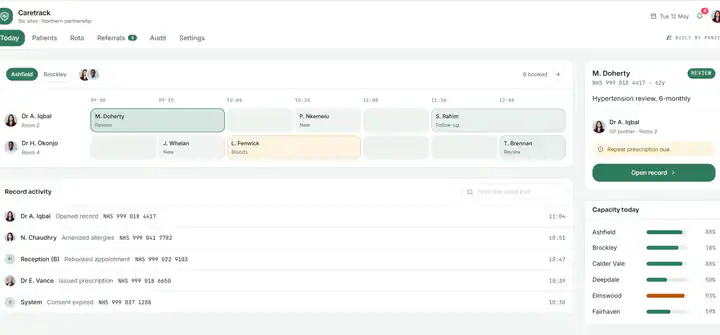
Web Application · Healthcare
Caretrack
Scheduling and records for multi-site clinics, with a complete audit trail built in.
6sites, one rota
Dashboards, portals and internal tools engineered for performance at scale, from thousands of records to millions.
The challenge
Internal software is often replaced because it has become too slow to use. Queries that perform well during development can degrade significantly as data volumes grow, and resolving this typically requires changes to how the application retrieves data.
Many organisations rely on spreadsheets for critical processes. These often lack validation, history and clear ownership, and their business rules are spread across formulas and individual knowledge. Replacing them begins with documenting and agreeing those rules.
Permissions become complex as portals grow. Resellers, regional managers, auditors and support staff each need different levels of access. A permission model designed at the outset keeps these rules consistent and maintainable.
What we deliver
Everything listed below is handed over to you at the end of the engagement.
Schema, indexes and access patterns designed for the queries your product runs and for the data volumes expected over the next three years.
Server-side pagination, filtering and sorting, streamed rendering and virtualised tables, with defined performance budgets.
Roles, scopes and record-level rules enforced at the data layer, so users only receive data they are authorised to see.
Connections to your existing systems with retries, idempotency and a visible sync history.
CSV exports, scheduled reports and audit trails, included as part of the core scope.
Process
Typical timelines. Exact durations are confirmed during the Discover stage.
1–2 weeks
We work with your team to document current processes, including exceptions and existing spreadsheets, and agree the business rules.
2 weeks
Schema, indexes, query patterns and the permission model, validated against realistic data volumes.
8–16 weeks
Two-week sprints against a database seeded at production scale, so performance issues are identified during development.
2–3 weeks
Historical data is imported and reconciled, systems run in parallel where appropriate, and a tested rollback plan is in place.
Technology
Application
Data is fetched on the server, so large datasets are not sent to the browser.
Data
Transactional and analytical workloads are separated where needed to keep dashboards responsive.
Quality
Test databases are seeded to production volumes so performance is tested realistically.
Performance problems in business applications rarely come from the framework. They usually come from a small number of data access patterns that are not visible with small development datasets but become significant in production.
The most common is the N+1 query, where a page loads a list of records and then makes an additional query for each one. With a small dataset this is imperceptible; with hundreds of records it results in hundreds of database round trips.
The second is loading entire datasets and filtering them in the browser. The solution is server-side pagination, filtering and sorting, so the browser requests only the data it needs.
The third is missing or ineffective indexes. An index that does not match the columns a query filters and sorts by will not be used, and the database will scan the full table instead. Query execution plans identify this quickly.
The most effective prevention is seeding development and test databases to the data volumes expected in production. Performance issues are then identified and resolved during development.
Related work
CaretrackWeb Application · Healthcare
Scheduling and records for multi-site clinics, with a complete audit trail built in.
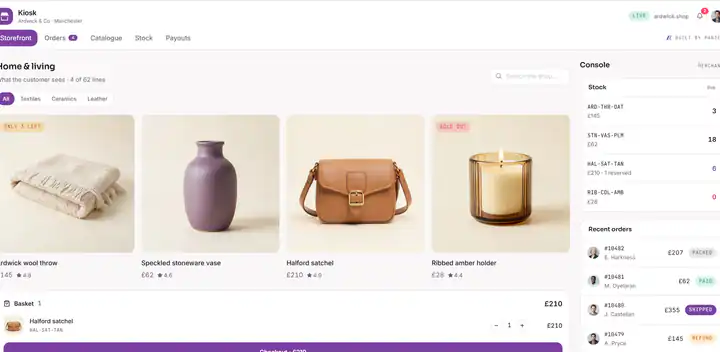
 Kiosk
Web Application · Commerce
A storefront and its merchant console, sharing a single product catalogue.
Engagement models
Pricing depends on scope and is provided after an initial consultation.
Replacing a known process where requirements can be defined before development.
Considerations
A separately priced discovery phase confirms requirements before the fixed scope is agreed.
A portal or platform with a long-term roadmap, working alongside your internal team.
Considerations
Requires a product owner on your side who can make decisions each week.
An existing application that needs continuous improvement and support.
Considerations
Best suited to maintenance and incremental features. Major new modules are scoped as separate projects.
Questions
Book a free 30-minute scoping call to discuss feasibility, budget and timeline.