 Rove
Mobile App · Field services
Rove
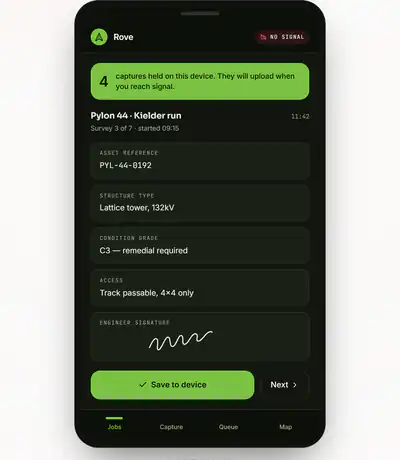
Offline-first inspection capture for field engineers, with photos, forms and signatures that sync when a connection is available.
0bars of signal required
iOS and Android apps from a single codebase, designed to work offline, with data synchronisation and app store submission managed end to end.
The challenge
Many mobile users work in environments with limited or no connectivity, such as warehouses, remote sites, hospitals and vehicles. Apps that assume a constant connection risk losing user data, which quickly undermines adoption.
Reliable offline support requires careful design. When several people edit the same record on different devices, or a device reconnects after several days, the app needs clear conflict-resolution rules agreed with the business.
App store submission also requires planning. Apple and Google each have specific review requirements for sign-in, permissions and privacy, and Android devices vary in how they manage background processes and battery optimisation.
What we deliver
Everything listed below is handed over to you at the end of the engagement.
React Native with native modules where required, combining shared logic with platform-appropriate interface conventions.
A local database on the device with a sync engine that queues, retries and resolves changes, so the app works fully offline.
Last-write-wins, field-level merge or manual resolution, selected for each data type with your team and documented.
Notifications on both platforms, and background sync that works reliably with each platform’s power management.
Store listings, privacy declarations, permission descriptions, review responses and resubmissions, with automated signing and release.
Process
Typical timelines. Exact durations are confirmed during the Discover stage.
1–2 weeks
We observe how your team works in its real environment to identify the key design requirements.
1–2 weeks
The local data model, sync protocol and conflict rules, agreed with your team before development begins.
8–16 weeks
Two-week sprints tested on physical devices, with builds distributed to your team through TestFlight and Google Play internal testing from the first sprint.
2–3 weeks
Testing across the devices your users carry, including extended offline testing to confirm no data is lost on reconnection.
1–3 weeks
Submission and review, with time allowed in the schedule for a possible resubmission.
Technology
Application
React Native with Expo is our default. Fully native development in Swift or Kotlin is used where an app depends heavily on the camera, background processing or intensive graphics.
Local data
A local database on the device ensures the app performs the same online and offline.
Backend and delivery
Automated build and release pipelines are in place from the first sprint.
Offline support is often described as a feature, but it is an architectural decision with a significant effect on cost and reliability.
A basic approach caches recent data so previously viewed screens still display without a connection. This does not support creating or editing data offline. An offline-first approach uses a local database as the primary data source. All reads and writes go to the device first, and a sync engine reconciles changes with the server when a connection is available.
This approach has three requirements. Records need identifiers that can be generated on the device. Write operations must be idempotent, so retried requests do not create duplicates. Each data type needs a defined conflict-resolution rule for when the same record is edited on multiple devices.
These requirements need to be designed before development begins. Adding offline support to an app built for constant connectivity typically means replacing the data layer.
Related work
RoveMobile App · Field services
Offline-first inspection capture for field engineers, with photos, forms and signatures that sync when a connection is available.
Engagement models
Pricing depends on scope and is provided after an initial consultation.
A defined app for a known workflow, with a target launch date.
Considerations
App store review times are outside anyone’s control, so the plan includes a buffer.
An app that will grow alongside your operations.
Considerations
Mobile releases follow app store review cycles, which planning must take into account.
A live app that needs OS updates, device support and new features.
Considerations
Covers the recurring work created by annual iOS and Android releases.
Questions
Book a free 30-minute scoping call to discuss feasibility, budget and timeline.